HF operating / Article 2
Reading HF Propagation From the Home Station
HF feels mysterious until the station starts keeping notes. Band, time, season, noise, antenna, and solar behavior turn random contacts into patterns you can actually use.
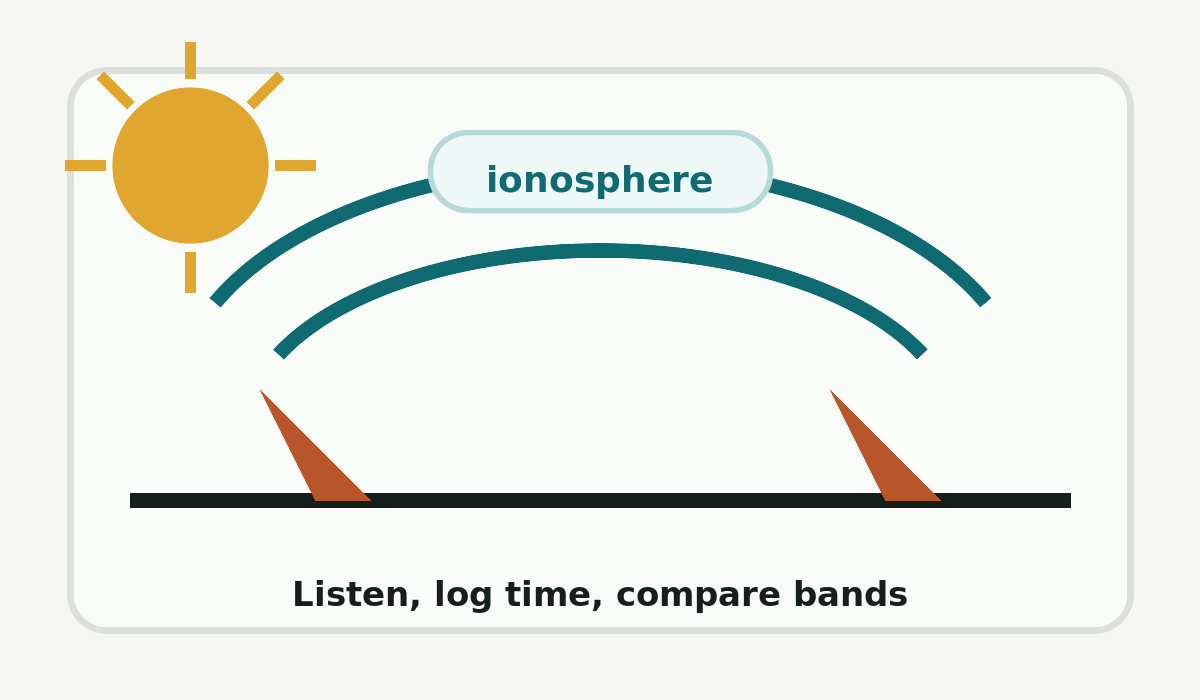
Treat Propagation as a Station Skill
HF operating rewards the operator who listens with a purpose. The ionosphere is not under our control, but our observations are. A station that logs time, band, mode, antenna, and noise level learns its own neighborhood. It learns when the lower bands wake up, when daytime paths are likely, and when a band is full of signals that are too weak to work.
The first step is to stop treating a failed contact as a failed station. Sometimes the band is not open. Sometimes the path is open in one direction and weak in another. Sometimes the station is hearing well but not being heard. Propagation is not an excuse, but it is a real operating condition that deserves evidence.
- Log the band even when no contact is made.
- Note whether the noise floor, not the signal strength, was the limiting problem.
- Compare the same signal on different antennas when possible.
Use the Clock as a Radio Control
The clock changes the band as surely as the tuning knob does. Morning, afternoon, sunset, evening, and overnight conditions are different operating environments. A band that sounds poor at noon may be useful near dusk. A band that is loud after dark may fall away as the sun rises. Time belongs in the log because time is part of the antenna system in practice.
Build a habit of short listening passes. Spend a few minutes on several bands instead of declaring the whole day dead after one sweep. If the station has an SDR, save screenshots or write short notes about strong carriers, broad noise, and visible activity. The point is not to predict everything. The point is to recognize familiar conditions faster.
- Check at least three bands before drawing a conclusion.
- Mark sunrise and sunset observations when they seem different.
- Record whether signals were steady, fluttery, watery, or fading fast.
Separate Noise From a Closed Band
Noise and propagation can be confused. A band might be open but buried under local electrical noise. Another band might be quiet because it is genuinely inactive at that hour. The distinction matters because the fix is different. Propagation asks for patience or a different band. Noise asks for station investigation.
Use known signals as markers. Time stations, beacons, broadcast signals, and familiar nets can show whether the receiver is hearing the outside world. If a known marker disappears only when a device in the house turns on, that is a local noise clue. If the whole band changes gradually around sunset, that is more likely propagation. Keep the observations modest and repeatable.
- Turn off likely noise sources during a receive-only test when it is safe to do so.
- Compare the station antenna with a smaller or temporary receive antenna.
- Note broad hash, single carriers, clicking pulses, and drifting tones separately.
Call When the Path Is Improving
Many good contacts happen during change. A signal that rises from the noise over several minutes may be a path opening. A band that suddenly gathers regional stations may be shifting toward useful coverage. Instead of spinning the dial constantly, pause long enough to hear whether the band is moving in your favor.
Calling at the right moment is a skill. Keep transmissions short, use reasonable power, and listen between calls. If a station is weak but improving, give the path time. If the signal is fading out, make the exchange clean and concise. HF rewards operators who match their pace to the band.
- Listen for several fading cycles before judging a weak signal.
- Use phonetics and clear reports when the path is marginal.
- Avoid long calls that cover up another station using the same opening.
Turn the Log Into a Local Propagation Guide
After a few months, a log can become a station-specific propagation guide. It will show which bands produced contacts at certain hours, which antennas were useful, and which days sounded noisy. A national propagation chart is helpful, but local notes reveal what happened at the actual station with the actual antenna and neighborhood noise.
Review the log before operating. If similar conditions produced a good regional net last month, try that band again. If a certain antenna always struggled on a certain path, plan a test instead of repeating the frustration. The goal is not perfect prediction. The goal is to operate with memory.
- Review old entries by band and hour.
- Mark unusual openings so they do not disappear into routine notes.
- Keep failed attempts in the log because they define the edges of what works.